California
City of Cathedral City
Reactive to Proactive Code Enforcement with streamlined workflows powered by City Detect

The Challenge
Cathedral City's Code Compliance department is committed to "enhancing the quality of life and visual aspects of the community through the administration of a fair and unbiased compliance program." However, several interconnected challenges prevented the department from operating proactively at the scale their mission required:
Operational Limitations:
Limited proactive capacity: Manual systematic surveys could only focus on a limited number of issues at a time, while complaint-based work dominated daily operations
Inefficient workflows: Manual processes like shopping cart searches or compiling fragmented data for reports consume staff time
Limited data: No comprehensive view of citywide conditions to identify patterns or measure impact
Limited cross-department coordination: Sharing blight information between code enforcement and Public Works required manual, case-by-case communication
Constrained career pathways: Administrative staff had few opportunities to develop technical or analytical skills
Traditional code enforcement workflows require officers to drive through neighborhoods looking for and manually documenting violations, a time-intensive and subjective process that Justin Gardiner, Cathedral City's Director of Code Enforcement, describes as inefficient. The department's shopping cart collection operations exemplified this challenge. Staff would deploy a four-person crew with a truck and trailer, plus a scout vehicle. One officer would drive around the city, manually identifying shopping carts and dropping pins on Google Maps while the collection team followed behind to collect the carts.
Beyond these operational constraints, Gardiner had a vision of transforming how code enforcement functions within municipal government. The department he envisioned was one where data-informed strategic decisions, administrative staff could grow into analytical roles, and where code enforcement collaborated seamlessly with other departments to address community blight holistically. To accomplish this vision and meet the mission, they needed a solution that could increase proactive enforcement capacity while enabling workforce development, cross-functional partnerships, and prevention-focused intervention. Achieving this would require not just powerful technology, but sustained human partnership: regular strategy sessions, platform customization to local priorities, responsive feature development, and comprehensive training and support.
The Solution
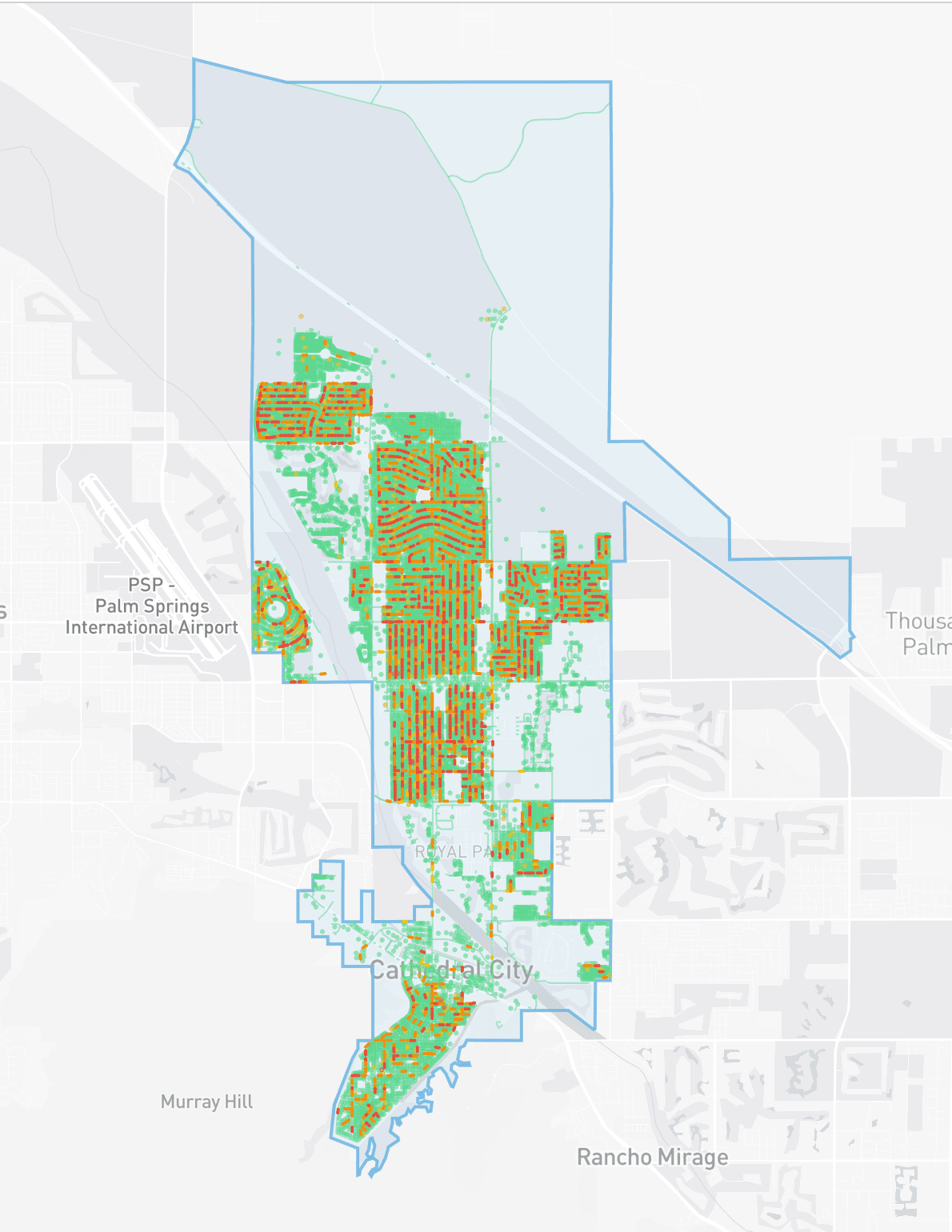
In June 2025, Cathedral City partnered with City Detect to address these interconnected challenges. The department implemented PASS AI®, City Detect's AI-powered computer vision platform, by equipping two city vehicles with data collection units (DCUs). These roof-mounted DCUs capture street-level imagery during routine city operations, turning routine drives into systematic condition assessments that identify multiple priority issues simultaneously.
How PASS AI® Addresses Cathedral City's Challenges:
Comprehensive proactive enforcement: A single sweep will detect dozens of potential issues across the roadway and parcels simultaneously, eliminating the need for separate, single-issue surveys
Streamlined workflows: Officers respond only to photographically documented detections instead of unverified complaints, while automated tools handle routing, courtesy notice generation, and reporting in minutes instead of hours
Centralized data platform: PASS AI® aggregates data at every scale—from individual parcels and road segments to districts and citywide—with filtering by detection type, blight severity, and review status for both public right-of-way and private property issues
Cross-department coordination: GPS-tagged detections can be exported and shared with Public Works and other departments
Workforce development opportunities: Administrative staff transform into strategic analysts who monitor compliance patterns through timestamped imagery, route only verified violations to field officers, generate district insights, and coordinate responses with Public Works
PASS AI® effectiveness depends on more than technology alone. Through weekly strategy sessions, responsive feature development tailored to Cathedral City's priorities, and comprehensive technical support, City Detect provides the partnership necessary to transform code enforcement operations.
How the System Works
Cathedral City's Code Compliance team operates on a structured schedule, with officers working weekend shifts, conducting full-city drives twice monthly. Vehicle-mounted DCUs capture imagery of roadside, parcel, and lot conditions on both sides of the street from the public right-of-way. The imagery uploads to the cloud platform regularly for processing.
By Monday morning, PASS AI® has analyzed the images, identified potential code violations and blight conditions, and assigned a severity score to each from 1 to 4. The platform visualizes this data on an interactive map, with color-coded indicators ranging from green (no visible blight) to yellow, orange, and red (most severe conditions). Staff can then review detections, filter by priority, and determine appropriate responses.
Gardiner describes the operational advantage: "It's out there collecting a bunch of data, and it's up to us to decipher through it. It's definitely a force multiplier. It doesn't overload us with work because you can still use your discretion, just like the officers out driving around proactively, they can use their discretion."
Comprehensive Proactive Enforcement
The system identifies a wide range of conditions across both code enforcement and public works operations in a single sweep. For code violations, PASS AI® detects issues such as abandoned vehicles (with telltale indicators like cracked windshields, deflated tires, cobwebs, and vegetation growth), vehicles parked on lawns or landscaping, tarps on roofs, and plywood covering doors or windows. For community blight affecting public spaces, the system identifies debris in public roadways, including shopping carts, illegal dumping, tire accumulations, snipe signs, and graffiti.
This multi-detection capability eliminates the need for separate, single-issue surveys. Where Cathedral City previously deployed dedicated crews to search specifically for shopping carts, PASS AI® now identifies shopping carts, abandoned vehicles, code violations, and public works issues simultaneously during routine drives. Officers can then prioritize their response based on severity scores and local enforcement priorities.
Streamlined Workflows & Automation
PASS AI® transforms time-intensive manual processes into automated workflows that take minutes instead of hours. The platform includes tools for detection review, courtesy notice generation, optimized routing, and report creation - all accessible within a few clicks.
Courtesy Notice Workflow
City Detect worked closely with Cathedral City to transform the manual process of creating courtesy notices into a personalized educational notice using PASS AI® detection imagery and simple notice generation & export tool. The courtesy notice includes:
A cover letter with the city logo explaining the Code Compliance department’s mission and available resources (in English and Spanish)
The actual detection from PASS AI® with violations physically highlighted and circled
Plain-language explanation of relevant municipal code sections and recommended corrective actions
A general resource flyer with contact information for assistance
These courtesy notices are the department's first contact with property owners and are sent before any formal enforcement action. "Complete courtesy at that point," Gardiner emphasizes. Administrative staff enter notes in PASS AI® and monitor properties during subsequent data-collection trips using timestamped imagery. Over three detection cycles, staff look for substantial improvement or attempts to contact the department. Only if property owners make no attempt at correction or contact does the administrative assistant open a case in the city's case management system and assign it to a code enforcement officer for investigation and potential citation.
For residents who acknowledge violations but lack resources to address them, Cathedral City has partnered with nonprofits like Community Action Partnership and Fair Housing Council to provide assistance, ensuring that enforcement doesn't disproportionately burden residents facing financial hardship.
Automated Reporting
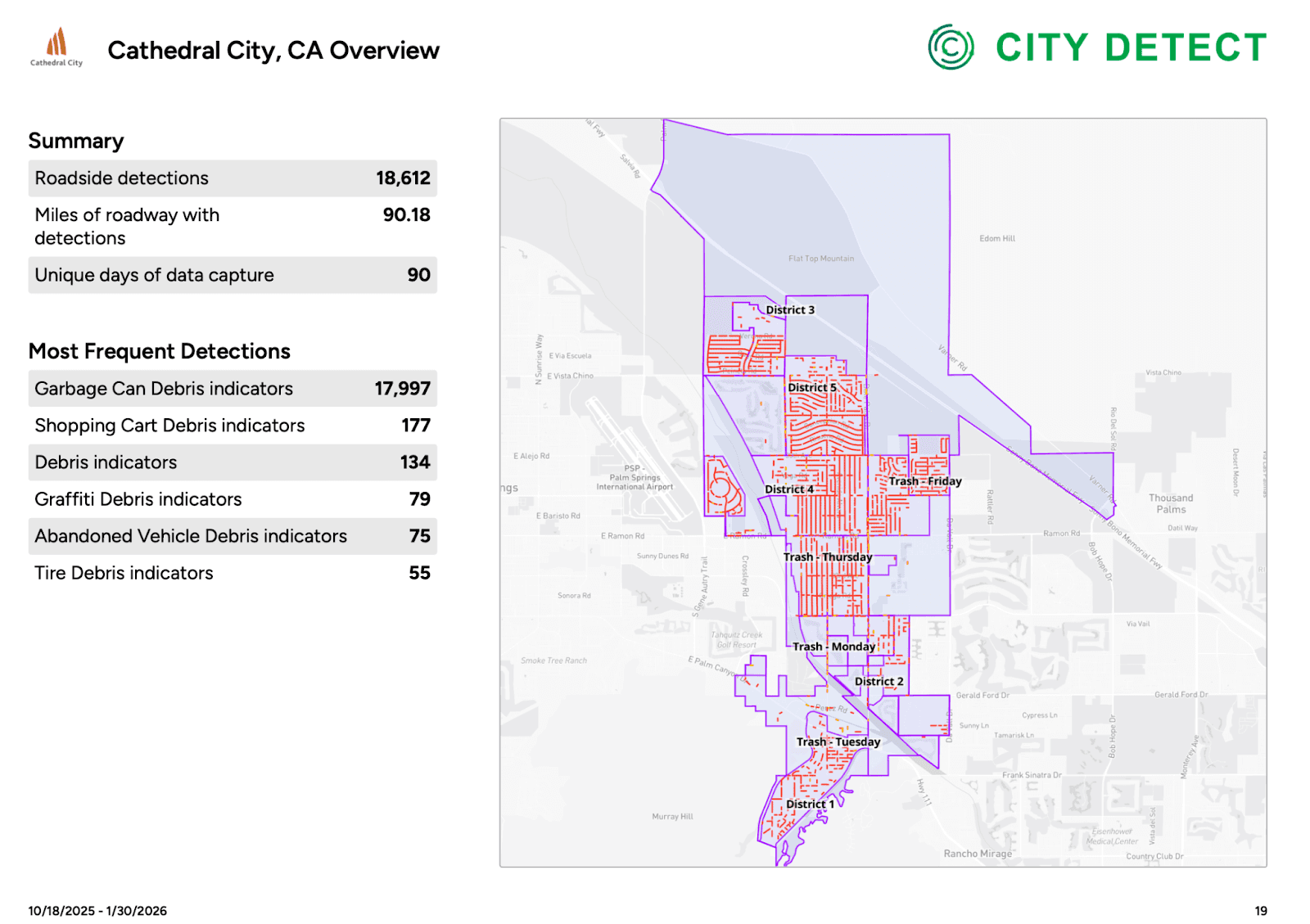
The platform automates report generation at multiple scales. Staff can produce district-level summaries, violation-type breakdowns, trend analysis over time, and customized reports for city management—all through the platform's interface without manual data compilation. What previously required hours of gathering data from disconnected systems now generates in minutes with a few clicks.
Centralized Data & Customization
PASS AI® provides a centralized platform where all detection data is aggregated at multiple scales - from individual parcels and road segments to district-level and citywide views. Staff can filter detections by type, blight severity, review status, and case assignments, enabling both granular investigation and strategic analysis.
Through the administrative interface, city staff configure which detection types appear in their review queues, ensuring officers focus only on locally relevant violations. Cathedral City, for example, disabled cracked driveway detection because it is not an enforcement priority. "We were running the reports at first and it was like, cracked driveway, cracked driveway, cracked driveway. And sometimes, some of the smallest cracks it would accurately identify and alert us," Gardiner explained.
Preset filter sets address specific scenarios: "Summer Lawn Issues" for seasonal enforcement or "Post Storm Recon" to streamline FEMA damage documentation after major weather events. Filter sets are also customizable to meet specific municipal priorities and initiatives.
Learn more about our post-storm detection work in Greenville, SC, after Hurricane Helene.
Local Calibration for Accuracy
City Detect performs local calibration for each municipality to reduce false-positive detections and align with local ordinances. For Cathedral City, calibration centers on municipal trash pickup schedules. The city's ordinances require residents to "always store garbage containers behind fence out of view of public within 12 hours after services," making accurate timing critical.
Gardiner emphasized the importance of this calibration: "I don't want to have a guy drive through let's say district three on a Tuesday and Tuesday is trash day. So then all of a sudden we're getting a bunch of essentially false reports." City Detect adapted PASS AI® to account for collection schedules, ensuring residents aren't flagged for cans set out on appropriate days - a feature that now benefits all municipalities.
Platform Evolution
City Detect consistently expands detection capabilities based on municipal feedback, prioritizing new models that address common enforcement challenges across cities. Models are refined collaboratively with the requesting cities before being made available to all users. This approach ensures the platform evolves to meet emerging needs while maintaining broad applicability across jurisdictions.
Cross-Department Integration
The system's utility extends beyond code enforcement. PASS AI® provides exact GPS coordinates and photographic documentation for public right-of-way issues like graffiti, tire dumps, and debris. Gardiner explains the partnership with Public Works: "We're using this for litter and debris also, and we've begun partnering with our Public Works department and producing the notices, and instead of sending them to a property owner, we're sending them to the public works manager as a courtesy…It gives the exact location, it will give the exact GPS pin drop, and I'll snap the picture and give that right over, and it's beginning to make Public Works job a little easier as well.”
Workforce Development & Training
City Detect provides comprehensive training that transforms how municipal staff interact with code enforcement data. Code Enforcement staff participate in regular training sessions and weekly strategy and feedback meetings, learning to extract and analyze detection data, monitor compliance patterns through timestamped imagery, and route cases strategically based on severity and compliance history. Staff learn to review detections across multiple drive-by cycles, identify patterns of non-compliance, generate district-level reports, and coordinate responses with other departments.
This professional development elevates administrative roles from clerical functions to strategic analysis. Cathedral City's administrative assistant now performs functions that blend data science with case management - capabilities developed through City Detect's structured training and ongoing support. This upskilling creates career advancement pathways within municipal teams while simultaneously increasing departmental efficiency.
The Results
The City Detect implementation fundamentally transformed Cathedral City's code enforcement operations, enabling capabilities that were previously impossible or impractical. While PASS AI® can detect over 100 indicators of urban blight, the platform is customized to each municipality's enforcement priorities. Cathedral City's executive reports display only the specific detection categories the department has selected to monitor, ensuring officers focus on locally relevant violations rather than being overwhelmed by comprehensive but potentially irrelevant data.
Detection Scale & Coverage
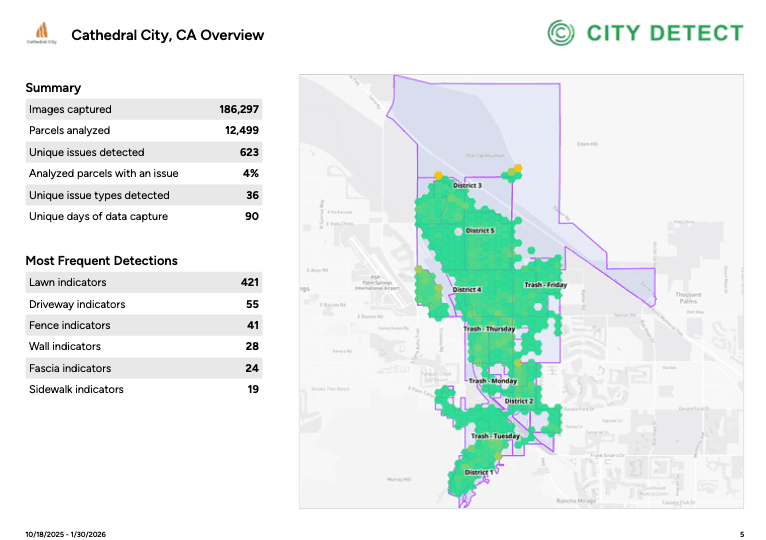
Between October 19, 2025, and January 30, 2026, PASS AI® captured 186,297 images and analyzed 12,489 parcels across Cathedral City's five districts. The system detected 623 unique parcel issues across 36 code violation types. Of all parcels analyzed, 4% had potential code violations.
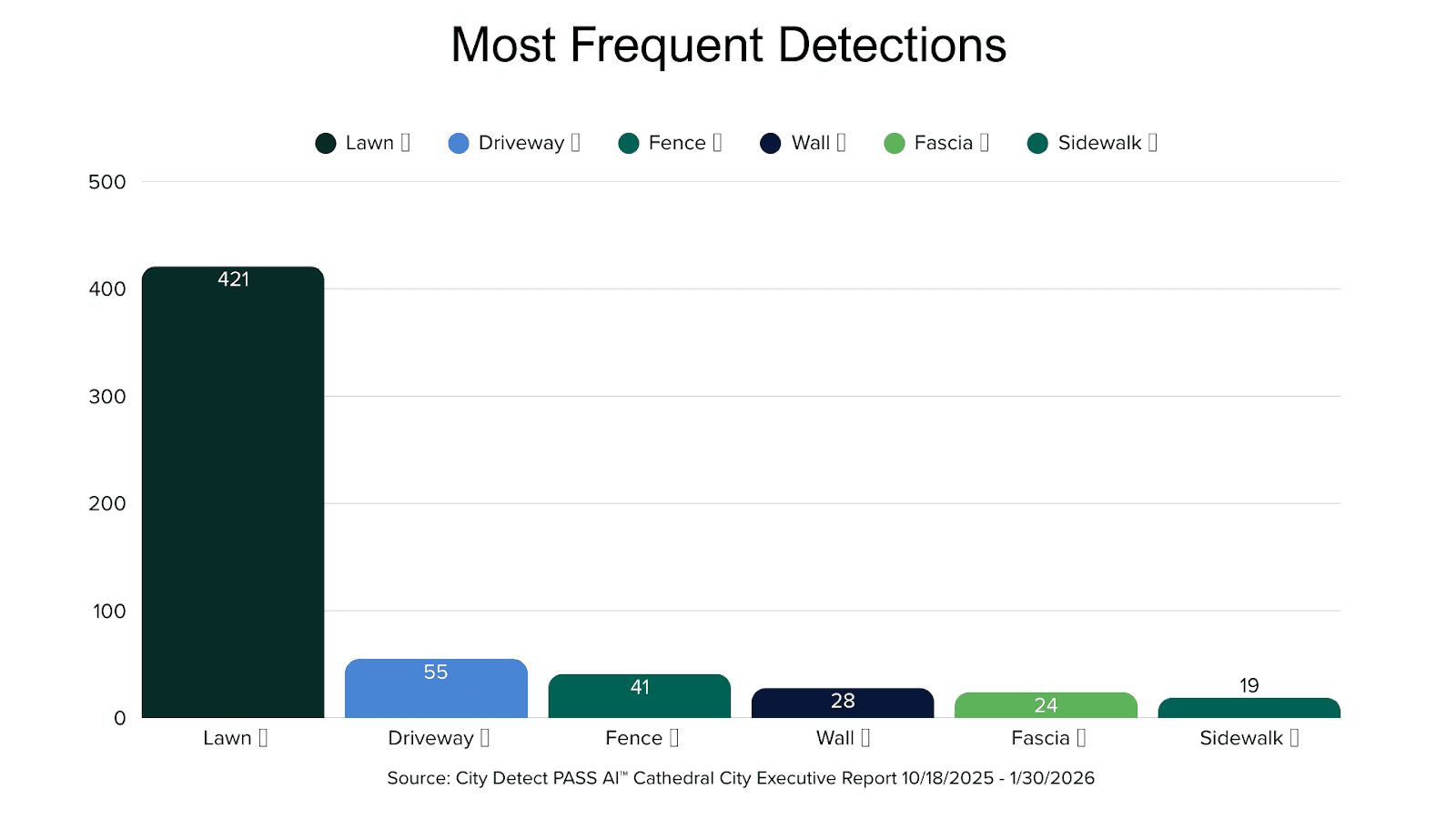
The most frequent parcel detections fell into six categories:
Lawn indicators - 421 detections
Driveway indicators - 55 detections
Fence indicators - 41 detections
Wall indicators - 28 detections
Fascia indicators - 24 detections
Sidewalk indicators - 19 detections
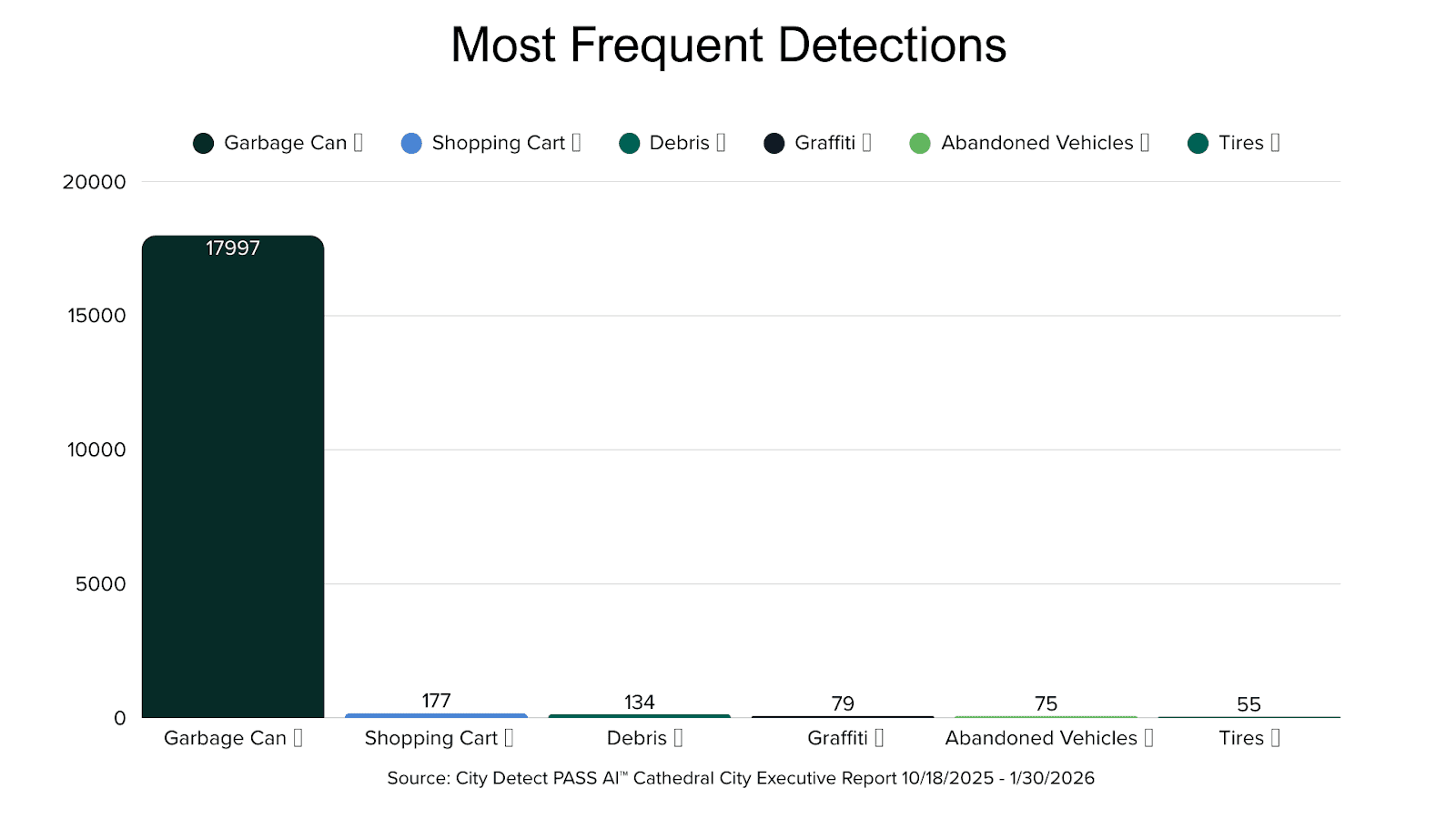
For roadside conditions, PASS AI® identified 18,612 detections across 90.18 miles of Cathedral City's 480 paved lane miles. The most frequent roadside detections include:
Garbage Can Debris - 17,997 detections
Shopping Carts - 177 detections
Debris - 134 detections
Graffiti - 79 detections
Abandoned Vehicles - 75 detections
Tires - 55 detections
Understanding the Blight Score System
In addition to detecting specific code violations, PASS AI® runs a comprehensive blight analysis that assigns each property a score from 1 to 4. This data-driven rating system evaluates a property's visual curb appeal, structural integrity, and aesthetic condition, empowering city leaders to identify and prioritize properties that may require intervention.
Properties fall into different categories based on the extent of visible issues. Blight Level 1 properties show no visible signs of deterioration or damage. Level 2 properties exhibit no more than a couple of minor issues, such as faded paint or small cosmetic defects. Level 3 properties show significant signs of disrepair or neglect, with widespread cosmetic damage or multiple structural issues that don't rise to the level of severe structural damage. Level 4 properties have severe structural damage or multiple serious issues and represent the greatest concern.

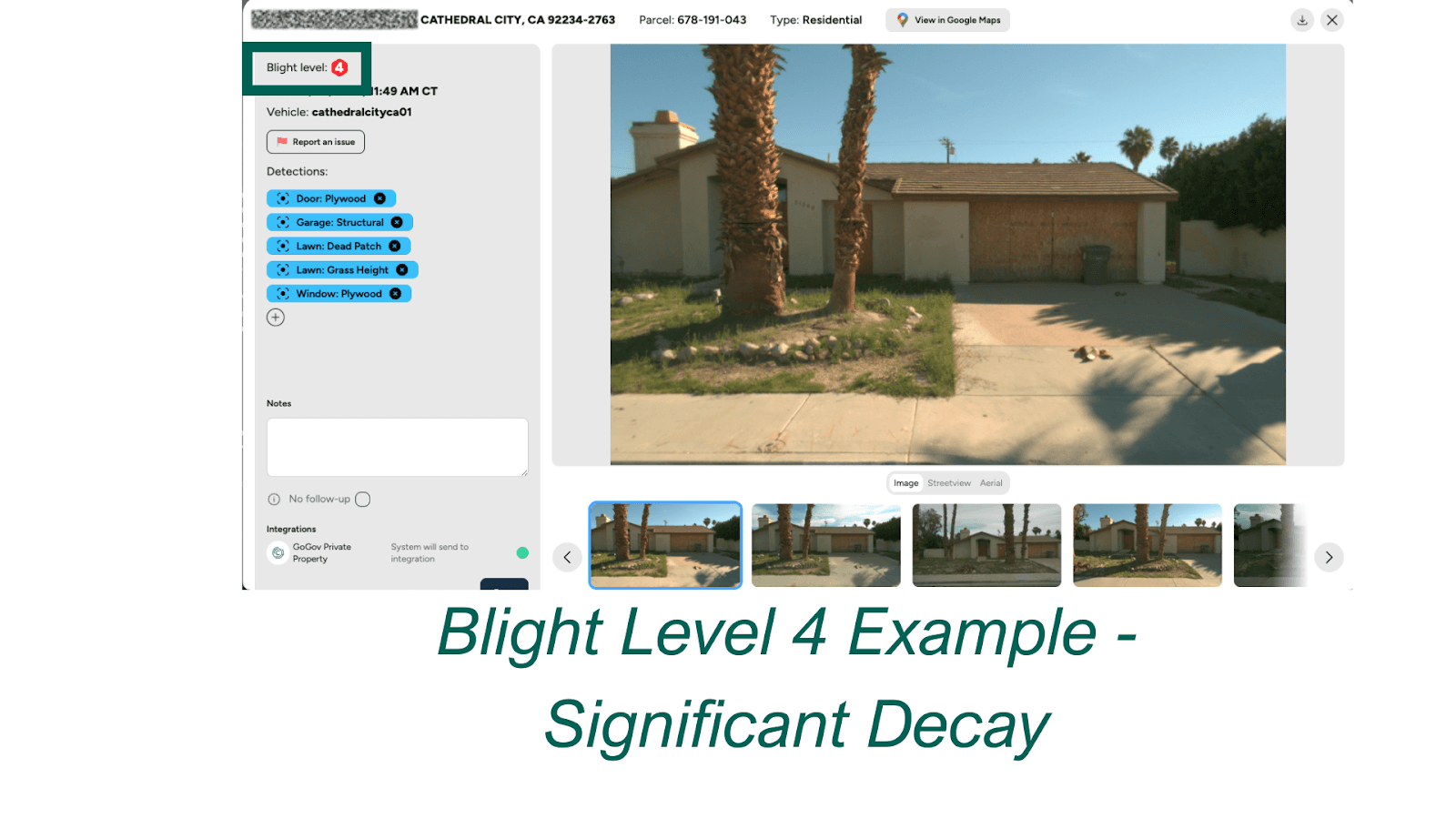
Certain indicators automatically trigger a Level 4 classification because they consistently signal abandonment or uninhabitability: broken or missing doors, plywood-covered doorways, broken or missing windows, plywood-covered windows, roof structural issues, tarps on roofs, and wall structural issues. Beyond these automatic triggers, the blight score calculation weighs structural issues more heavily than aesthetic or lawn indicators. For example, a property with two structural issues may receive the same blight score as a property with four aesthetic or lawn issues. It's important to note that parcels can have multiple detections—the total parcels analyzed represent all properties assessed, while parcel detections indicate individual issues identified, which may number several per property.
Blight Score Analysis: Prevention and Prioritization
For Cathedral City, the blight score analysis was run across all five districts. The numbers tell a fascinating and complex story. District 1, despite analyzing fewer parcels (2,189) than Districts 3, 4, or 5, showed the highest percentage of parcels with any issue at 6.53%. District 3, by contrast, had the lowest detection rate at just 2.54% across 2,756 parcels analyzed. Perhaps most revealing: severe blight (scores of 3 or 4) affected fewer than 0.3% of parcels in any district, with only 14 properties citywide receiving these highest scores. This data validates Gardiner's approach of focusing on "low hanging fruit and 25% of cases that are egregious"—the numbers confirm that truly severe issues are concentrated in a small, identifiable subset of properties that can be systematically prioritized.
Area Name | Parcel Detections | Blight Score 1 | Blight Score 2 | Blight Score 3 | Blight Score 4 | Total Parcels Analyzed | % With Blight Score 3 or 4 | % With Any Issue |
District 1 | 164 | 2,102 | 82 | 0 | 5 | 2,189 | 0.23% | 6.53% |
District 2 | 91 | 1,075 | 45 | 0 | 3 | 1,123 | 0.27% | 6.68% |
District 3 | 75 | 2,699 | 56 | 0 | 1 | 2,756 | 0.04% | 2.54% |
District 4 | 172 | 2,920 | 90 | 0 | 3 | 3,013 | 0.10% | 4.88% |
District 5 | 120 | 3,325 | 81 | 0 | 2 | 3,408 | 0.06% | 3.29% |
However, the real value of PASS AI® extends beyond identifying these 14 Level 4 properties. Code enforcement officers typically know their communities intimately—they often live, work, and play in the cities they serve, and the most problematic properties often have established reputations. The harder challenge lies in tracking decline: identifying when a property slides from Level 2 to Level 3, and potentially to Level 4, especially when these properties are scattered across different districts. Across Cathedral City's 12,489 analyzed parcels, 354 properties scored at Level 2, representing potential intervention opportunities before minor issues escalate into severe structural problems. PASS AI® creates systematic visibility into this gradual deterioration, further prioritized and filtered by detection type, enabling the department to offer educational courtesy notices and resources before properties require formal enforcement action. This preventive approach aligns with Gardiner's strategic focus—addressing egregious cases decisively while creating opportunities to prevent other properties from reaching that point through early, supportive intervention.
A concern often raised by code enforcement officers is that PASS AI® will create an overwhelming workload. Cathedral City's experience demonstrates the opposite. While Gardiner intended to focus on egregious cases, the data showed that the share of parcels in the worst condition was less than 1%. This allows his code enforcement team to approach enforcement and education with laser focus on what will make the most meaningful impact.
Roadside Detection Patterns Across Districts
The roadside detection data reveals distinct patterns that enable strategic resource allocation across Cathedral City's five districts. Districts 4 and 5 show the highest absolute numbers of detections (4,893 and 4,423, respectively), though this correlates closely with their more extensive geographic coverage—District 5 covers 22.31 miles of roadway while District 4 covers 22 miles.
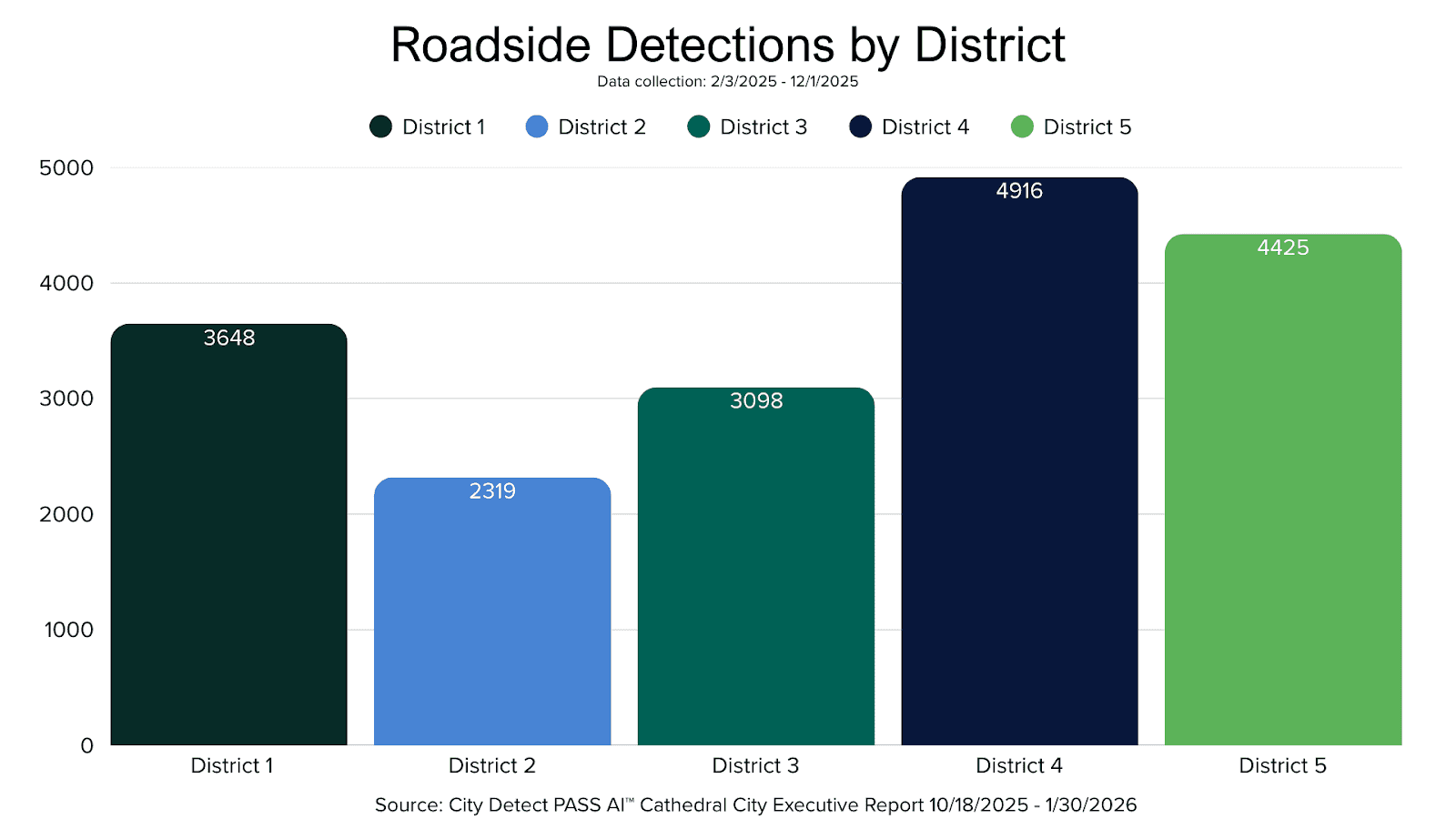
Garbage can debris dominates overwhelmingly across all districts, accounting for 96.7% of all roadside detections (17,805 of 18,406 total). Beyond garbage cans, the data reveal neighborhood-specific challenges that require tailored approaches. Shopping carts are concentrated in Districts 4 (75 detections) and 2 (45 detections), suggesting these areas would benefit most from optimized collection routing. Graffiti appears almost exclusively in Districts 1 (42 detections) and 2 (10 detections), indicating localized vandalism patterns that warrant district-specific prevention and rapid response rather than citywide programming.
District 3 presents a unique profile. While it shows the lowest percentage of parcels with blight issues (2.54%), it has notable concentrations of debris fields (5 detections) and parcel snipe signs (7 detections)—issues that barely register in other districts. These patterns likely reflect different land-use characteristics or illegal dumping behaviors specific to District 3's geography.
Operational Workflow Outcomes
Courtesy Notice Engagement
By mid-December 2025, the department had sent approximately 500 courtesy notices, leveraging the personalization capabilities of PASS AI®. The response validated the educational approach: approximately 40% of recipients contact the department within a week of receiving their notice, often seeking clarification or requesting additional time to correct violations. Administrative Code Compliance Specialist Anika Sanchez handles these, explaining the detection system and working with residents on compliance timelines. "Those are usually really quick. They'll take care of those or they'll call me and say, 'I didn't know I couldn't do that,'" Sanchez noted. Many residents are simply unaware they're in violation and appreciate the notification and resources.
Early compliance data shows promising results. Sanchez estimates that between 30% and 40% of properties achieve voluntary compliance before any follow-up contact, particularly for highly visible violations such as debris in driveways or vehicles parked on landscaping. Voluntary compliance is identified through successive PASS AI® images demonstrating that the violation has been resolved. For properties that don't achieve voluntary compliance within 30-60 days, Sanchez escalates the case to a code enforcement officer, with many violations resolved at that stage through direct officer engagement.
Shopping Cart Identification and Routing
PASS AI® identified and pinpointed 177 shopping carts across the city during the reporting period. Where the department previously deployed a four-person crew plus a scout vehicle driving through the city searching manually, only one officer and one administrative staff member are needed to gather the data and generate a comprehensive report showing all identified shopping carts.
Abandoned Vehicle Abatement Baseline
For Abandoned Vehicle Abatement (AVA), the system provides what Gardiner calls a "scary accurate" baseline for potential cases. While the AI cannot make legal determinations about whether a vehicle qualifies as abandoned, junk, wrecked, or dismantled, it identifies telltale indicators: cracked windshields, deflated tires, cobwebs, and vegetation growth around vehicles. AVA officers can generate daily task lists of potential cases to investigate, replacing speculative neighborhood drives with targeted field investigations.
California's Abandoned Vehicle Abatement (AVA) program provides state reimbursement to municipalities for processing abandoned-vehicle cases, creating a direct link between systematic enforcement and financial sustainability. This systematic approach ensures Cathedral City captures the full scope of abandoned vehicles citywide, maximizing eligible state reimbursement rather than missing cases due to limited patrol coverage.
"Every time you send a notice, you get paid if they correct it right," Gardiner noted. "If we are able to start using this and hitting that map faster and going out and hitting all those notices and then driving by again next week and the vehicle's gone, and we can see through the date/time-stamped photo the next time we drive by that it's gone, we just got paid."
PASS AI®'s timestamped documentation provides the evidence trail required for state reimbursement claims, ensuring the city receives appropriate financial support for the true volume of AVA work being performed.
Context-Informed Enforcement at Scale
The system's accuracy allows for discretionary enforcement across the entire city. "It doesn't overload us with work because you can still use your discretion, just like the officers out driving around proactively, they can use their discretion," Gardiner explained. Officers can prioritize cases based on blight scores, focusing on the most egregious violations while monitoring lower-severity cases for progression or voluntary compliance.
The Impact
Cathedral City's implementation of PASS AI® demonstrates that transformative municipal technology requires more than detection capabilities—it requires skilled officers, responsive governance, and collaborative partnership. This combination creates measurable efficiency gains while simultaneously reshaping workforce structures and establishing new precedents for technology adoption in local government.
Comprehensive Proactive Enforcement at Scale
PASS AI®'s multi-detection capability fundamentally expanded Cathedral City's enforcement reach. Where the department previously conducted single-issue surveys—like dedicated shopping cart searches—they now simultaneously identify dozens of violation and blight categories during routine drives. The 623 parcel violations across 36 issue types, plus 18,612 roadside detections, represent a scope of systematic observation impossible through traditional manual methods.
Equally transformative is the regularity of comprehensive assessment. Twice-monthly full-city drives create a continuous municipal asset inventory and roadside condition monitoring system. Every district receives systematic review on a predictable cadence, replacing sporadic complaint-driven enforcement with consistent citywide coverage. This regular interval capability allows the department to track property conditions over time, identify emerging patterns, and intervene before minor issues escalate—advancing the department's mission of "fair and unbiased compliance" across all neighborhoods.
Streamlined Workflows: Operational Efficiency Gains
The implementation fundamentally changed how Cathedral City's code enforcement team allocates time and resources, shifting from speculative searching to strategic intervention.
Shopping Cart Collection Transformation
The shopping cart collection workflow exemplifies PASS AI®'s operational impact. Previously, Cathedral City deployed a four-person crew with a truck and trailer, plus a scout vehicle with a driver who would manually locate shopping carts throughout the city while the collection team followed. The new workflow eliminates the need for purely intuition-based searching entirely.
Gardiner explains the transformation: "Now my officer drives around the whole city, and the next morning, I can go in, hit a button that says show me all the shopping carts then I hit a button that says 'route me.' It will then take me from city hall to every single identified shopping cart and back to city hall in the most efficient route. And we can export it to Google Maps or Apple Maps. So now it's completely expedited."
The efficiency gains extend beyond time savings to working conditions. "This is important to us, especially when it's 150,000 degrees outside," Gardiner noted. "It's improving and speeding up a lot of our normal processes. It's making us more efficient."
Field Officer Time Reallocation
A persistent challenge in code enforcement is that approximately 25% of resident-initiated complaints prove to be either unfounded or unactionable upon investigation. Officers now prioritize photographically documented detections over unverified complaints or traditional patrol-based observations.The administrative team's filtering process (monitoring properties across three detection cycles before escalation) ensures field officers engage only with properties requiring human investigation. This eliminates unproductive field visits to properties already moving toward compliance or where resident complaints are inactionable.
Similar efficiency gains apply to Abandoned Vehicle Abatement (AVA) operations, where officers filter and review photographic documentation of potentially abandoned vehicles rather than driving through neighborhoods. The system's identification of telltale indicators (cracked windshields, deflated tires, cobwebs, vegetation growth) provides AVA officers with prioritized targets for investigation.
Centralized Data Platform: Data-Driven Educational Interventions
PASS AI® transformed Cathedral City's approach from reactive complaint response to strategic, data-informed decision-making at multiple scales.
District-Level Interventions
The system generates comprehensive data that enables strategic, district-level interventions. By overlaying violation data with GIS mapping of council districts, the department can identify neighborhood-specific issues and design targeted educational interventions. "In District 1 a pervasive problem is parking on landscaping," Gardiner explained. "Now we can start to design mailers or courtesy notices for that particular neighborhood because that's an issue there whereas in District 4, it might not be."
This granular analysis revealed patterns invisible in complaint-based enforcement: Districts 1 and 2's graffiti concentration, District 3's debris field and snipe sign issues, Districts 2 and 4's shopping cart challenges. Each pattern now informs district-specific resource allocation and prevention strategies.
Management Reporting and Transparency
The centralized platform addresses a critical pain point for code enforcement leadership: producing data for city managers and council members. "If you're in management or supervision and you have to produce data to your city manager or council, this stuff is going to tell them everything they want to know, the snapshot of the city right now," Gardiner stated.
What previously required manual data compilation across disconnected systems can now be generated in minutes: district-level summaries, violation-type breakdowns, and blight score distributions. This reporting capability transforms code enforcement from a largely invisible municipal function to one with clear, demonstrable metrics of community impact.
Supporting Grant Applications and Community Development
Beyond internal reporting, the comprehensive data support municipal development grant applications. Programs like Community Development Block Grants (CDBG), Choice Neighborhoods, and state housing initiatives require jurisdictions to document existing conditions, demonstrate need, and establish baselines for measuring improvement. PASS AI®'s systematic documentation—including blight scores, geographic distribution of conditions, and timestamped evidence of decline or improvement—provides the quantitative foundation these applications demand.
The Town of Prescott Valley, Arizona, leveraged similar detection data to strengthen their grant narratives with objective, comprehensive condition assessments rather than anecdotal evidence or limited manual surveys. For resource-constrained municipalities, this data infrastructure can mean the difference between competitive and unsuccessful grant applications.
Learn more about how Prescott Valley used PASS AI® to accelerate grant requirements and reporting.
Preventive Intervention Strategy
Perhaps most significantly, the data enables a preventive approach to blight management. The identification of 354 Level 2 properties provides intervention opportunities before minor issues escalate to severe structural damage. Rather than waiting for properties to become neighborhood eyesores requiring aggressive enforcement, the department can offer educational resources and courtesy notices at the first signs of decline. This strategy aligns enforcement with documented best practices and the department's mission to "enhance the quality of life and visual aspects of the community through the administration of a fair and unbiased compliance program." Studies show that this type of proactive engagement, such as contacting property owners early, redesigning violation notices to specifically highlight the violation, and following up consistently, can improve compliance by up to 14.7% and reduce enforcement costs by 6% to 15% (see Nudging Early Reduces Administrative Burden: Three Field Experiments to Improve Code Enforcement).
Cross-Department Collaboration
PASS AI® broke down operational silos between code enforcement and other municipal departments, creating a systematic information-sharing system where ad hoc communication previously existed.
Public Works Partnership
The department now generates reports on illegal dumping, litter, debris, graffiti, and tire accumulations detected in public rights-of-way. Rather than sending notices to property owners for issues outside their control or having Public Works conduct separate surveys, code enforcement proactively shares exact GPS coordinates and photographic documentation with the Public Works manager.
"We're using this for litter and debris also, and we've begun partnering with our public works department and producing the notices, and instead of sending them to a property owner, we're sending them to the public works manager, as a courtesy, hey, we have some illegal dumping across the street," Gardiner explained. "Because it gives the exact location, it will give the exact GPS pin drop, and I'll snap the picture and give that right over, and it's beginning to make the public works job a little easier as well."
This coordination eliminates duplicate effort—both departments were previously identifying many of the same issues through separate processes—while ensuring faster response to public space maintenance needs. The administrative assistant now supports Public Works operations by generating these reports, demonstrating how a single position can amplify efficiency across multiple departments.
Workforce Evolution and Development
The implementation created tangible workforce development outcomes, validating Gardiner's philosophy that AI would "modify your workload" rather than eliminate positions.
Administrative Role Elevation
The implementation elevated one administrative position from traditional clerical functions to strategic analyst responsibilities. Through City Detect's training programs and weekly strategy sessions, Cathedral City's administrative assistant developed capabilities in:
Compliance pattern analysis through timestamped imagery review
Evidence-based case routing and escalation decisions
District-level data extraction and reporting
Cross-department coordination and communication
Strategic case management aligned with enforcement priorities
This upskilling created a critical efficiency multiplier for the department. The assistant reviews detections that have received educational courtesy notices, monitoring their timestamped images across multiple detection cycles. They escalate only cases that show documented patterns of non-compliance to field officers for investigation—a filtering process that eliminates unproductive fieldwork and allows officers to concentrate on properties requiring investigation rather than those already moving toward compliance.
The transformation extends beyond individual skill development to departmental value. What was once a clerical position now generates district insights, produces management reports, coordinates multi-department responses, and makes strategic decisions about case escalation—all accomplished in a few clicks within PASS AI® rather than hours of manual data compilation.
Creation of New Municipal Job Classification
Most significantly, the PASS AI® implementation prompted Cathedral City to create an entirely new position in local government. Gardiner is working with an HR consulting firm to develop a job classification for a "Code Compliance Specialist," a hybrid role combining administrative functions with field officer responsibilities, with specific emphasis on AI system management and case management.
According to Gardiner and his HR consultants, this position type does not currently exist in local government. "I'm right now in communication with HR Consulting in creating a brand new job class - which is a hybrid between an admin type role and a field officer role with an emphasis completely on AI and case management," Gardiner stated.
The creation of this role signals a fundamental shift in how municipalities may structure code enforcement teams in an AI-augmented environment. Rather than replacing human code enforcement officers, the technology is creating new specialized positions that require different skill sets: data analysis, AI system administration, case workflow optimization, and strategic enforcement coordination. The implementation resulted in a net expansion rather than displacement of Cathedral City's municipal workforce.
Field Officer Role Evolution
For field officers, the technology shifted time allocation from patrol-based observation and manual violation identification to relationship-building, case resolution, and discretionary judgment. Officers still make contact with property owners, conduct inspections, and make legal determinations about violations—the human element Gardiner describes as essential to code enforcement.
"There will always, always be a human element to code enforcement," Gardiner emphasized. "We wear, as you know, how many hats a day? I go from a marriage counselor to enforcement officer to a building inspector, to you name it, making connections with adult protective services, or nonprofits."
PASS AI® doesn't replace these interpersonal skills; it ensures officers can apply them where they matter most, focusing on cases requiring human judgment rather than spending hours searching for violations that may not exist.
Establishing Legal and Operational Precedent
Cathedral City's implementation demonstrates how AI-powered detection systems can operate within established legal frameworks for municipal code enforcement. The department's approach centers on a clear principle: PASS AI® captures only what code enforcement officers are already authorized to observe from public rights-of-way during regular duties.
Gardiner framed the legal foundation simply: "I asked a question, what's the difference between my code officer leaning out the window and snapping a picture and [the PASS AI® DCU] going on the roof. It's the road right of way, the public right of way." The system operates under the same legal boundaries that have governed code enforcement for decades: observing conditions visible from public streets where there is no reasonable expectation of privacy.
The legal principle of curtilage, which protects the immediate surroundings of a home from unreasonable observation, does not extend to views from public streets. As Gardiner explained when addressing privacy concerns: "If your concern is that my AI camera is going to get a picture of you in your [underwear] taking your trash out, maybe you shouldn't take your trash out in your [underwear]." There's no curtilage protection from the middle of the road; the cameras capture what is already publicly observable, similar to how Google Street View operates.
Cathedral City's approach began approximately 18 months before implementation, with Gardiner gradually introducing the concept to stakeholders. This timeline allowed for thorough vetting of legal frameworks, addressing questions about privacy protections, and building an understanding of how the technology operates within existing constitutional boundaries. The result is a model that other municipalities can reference when evaluating AI-powered code enforcement tools: one grounded in established legal principles rather than creating new surveillance authorities.
Adoption Trajectory
Gardiner predicts broader adoption of AI across the code enforcement field. "It definitely is coming, it's changing the game. I believe you're going to see more and more jurisdictions adopting some type of AI technology for their code enforcement officers," he stated during his California Code Enforcement Officers (CACEO) conference presentation on the system.
Cathedral City's experience demonstrates that successful implementation requires both technological capability and strategic partnership, but the operational benefits and workforce development opportunities position AI-powered detection as an increasingly viable solution for resource-constrained municipalities.
Conclusion
Cathedral City's implementation of PASS AI® demonstrates how computer vision and AI can transform municipal code enforcement from reactive, resource-constrained operations into proactive, data-driven programs. The department achieved this transformation by equipping its team with AI-powered tools that amplify their existing expertise and efficiency.
The case extends beyond operational efficiency to workforce innovation. By creating new job classifications, upskilling existing staff, and redefining how code enforcement officers allocate their time, Cathedral City is modeling a future where AI augments rather than replaces municipal workforces. The creation of the Code Compliance Specialist position may mark the first in a new category of public sector roles specifically designed for AI system management.
Cathedral City's experience offers key insights for municipalities considering similar implementations. Proactive stakeholder engagement proves essential for addressing privacy concerns. Legal frameworks around public right-of-way observation provide a solid footing for AI-powered detection. Most importantly, the technology creates opportunities for workforce development rather than displacement.
As more jurisdictions face the challenge of maintaining community standards with static or declining resources, Cathedral City's model provides a roadmap for leveraging AI to enhance municipal capacity while creating new professional opportunities for government employees.