4
min read
Taking Advantage of Community Members with Snipe Signs
Snipe signs aren’t just visual clutter—they’re a predatory marketing tactic that disproportionately targets vulnerable neighborhoods with fraudulent or exploitative services. This blog explores the real community harm behind these signs and how cities can move from endless cleanup to data-driven enforcement that protects residents.h

Josie Cantrell
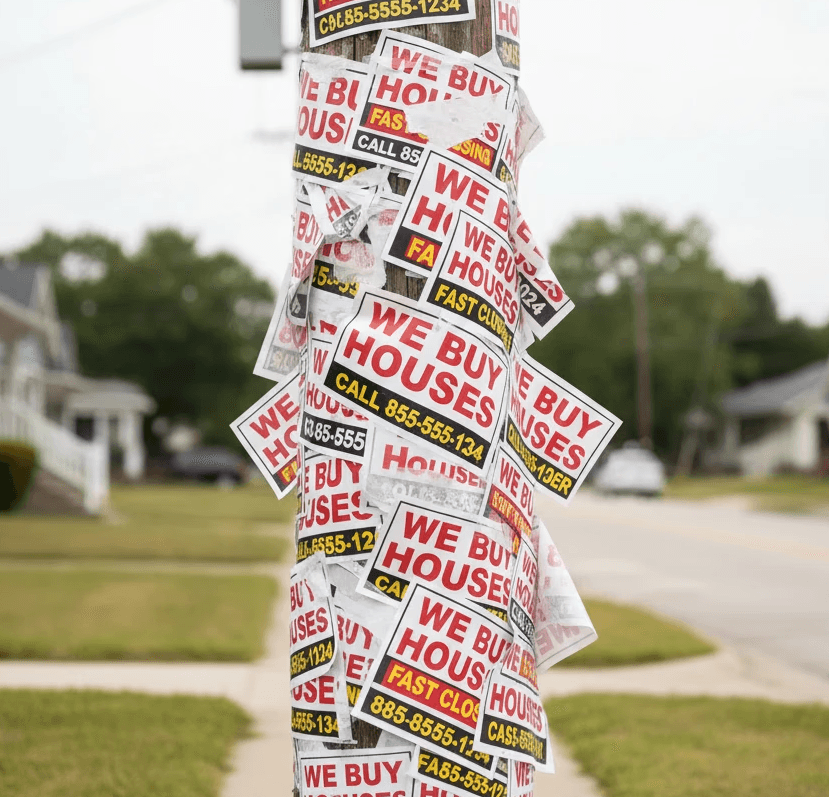
Every city has them: small, unauthorized signs stapled to utility poles, stuck in rights-of-way, or taped to street corners. "We Buy Houses 4 Cash." "Quick Loans—No Credit Check." "Work From Home $$$$." They appear overnight and multiply faster than code enforcement can remove them.
But snipe signs aren't just an aesthetic nuisance or a code violation. They're a targeted marketing strategy, and the targets are often the most vulnerable members of your community.
The Predatory Playbook: Who Snipe Signs Target
Research consistently shows that snipe signs are not randomly distributed. Lower-income and minority neighborhoods experience disproportionate concentrations of outdoor advertising, including snipe signs. This isn't a coincidence, it's strategy.
The services advertised on snipe signs frequently exploit financial desperation or lack of access to traditional services:
Cash-for-houses schemes that pressure homeowners into below-market sales, often targeting those facing foreclosure or financial hardship.
High-interest "quick cash" loans from unlicensed lenders offering predatory terms to people locked out of traditional banking.
Credit repair services offering to fix poor credit quickly target cash-strapped borrowers who need a minimum credit score.
Work-from-home scams promising unrealistic income to people struggling with unemployment or underemployment.
Unlicensed contractors offering cut-rate services that leave residents with substandard work and no recourse.
What makes predatory snipe signs so insidious is that they blend in with legitimate community notices. A hand-lettered garage sale sign sits next to a slick "We Buy Ugly Houses" advertisement. A neighborhood yard sale announcement shares the same utility pole as a payday loan offer. This camouflage allows predatory actors to exploit information asymmetry, financial stress, and limited consumer protections in communities that can least afford the harm, all while appearing as just another neighbor trying to sell a couch or advertise a community event. It also complicates enforcement: code officers must distinguish between pro-social community announcements and harmful commercial advertising, often under tight resource constraints and without the ability to regulate based on message content.
Beyond Clutter: The Real Community Cost
The impact of snipe signs extends far beyond visual pollution. Studies document measurable harm to community well-being:
Psychological toll: Research links the presence of excessive outdoor advertising, including snipe signs, to increased stress, anxiety, and "visual oppression"—a sense of being overwhelmed or pressured by advertising clutter that makes public spaces feel dominated by commercial interests rather than community needs. These psychological effects are more pronounced in neighborhoods already facing economic challenges, compounding existing stressors with constant exposure to messages that often target residents' financial vulnerabilities.
Property devaluation: The presence of excessive signage contributes to perceptions of urban decay and disorder, potentially lowering property values and deterring investment in neighborhoods that need it most.
Traffic safety hazards: Research documents that excessive signage distracts drivers and disrupts traffic flow, creating immediate public safety risks.
Promotion of illegal and fraudulent services: Studies show that snipe signs frequently advertise unregulated or illegal services, including fraudulent schemes that harm community members.
Surveys consistently show that residents view snipe signs as a nuisance and overwhelmingly support stricter regulation. Yet many cities lack effective enforcement frameworks, allowing the problem—and the harm—to persist.
The Legal Question: Can Communities Fight Back?
This raises an important question: if snipe signs cause demonstrable community harm and target vulnerable populations, can municipalities regulate them based on content?
The legal landscape is complex. The 2015 Supreme Court decision in Reed v. Town of Gilbert established that sign ordinances distinguishing between message types face strict constitutional scrutiny. But strict scrutiny doesn't mean regulation is impossible—it means courts will carefully examine whether there's a compelling government interest and whether the regulation is narrowly tailored to serve that interest.
"Courts recognize that not all speech is protected equally, especially when it causes direct harm," explains Gavin Baum-Blake Esq., CEO of City Detect. "The classic example is you can't yell 'fire' in a crowded theater. Similarly, advertising that preys on vulnerable populations, promotes illegal activity, or constitutes fraud may fall outside First Amendment protections. But municipalities need to build a careful evidentiary record showing the harm and demonstrating that their ordinance targets that harm specifically, not just messages they dislike."
This is where documentation becomes critical. Cities that can demonstrate these factors have a stronger foundation for defending regulations that go beyond purely location-based enforcement:
Disproportionate targeting of vulnerable neighborhoods
Connections between snipe signs and consumer harm complaints
Public safety impacts (traffic hazards or code violations)
Community input showing resident concerns
A Multi-Layered Response
Protecting communities from predatory snipe signs requires more than just removal; it demands a comprehensive strategy:
1. Content-neutral baseline enforcement: Consistent removal of all signs in rights-of-way, on public infrastructure, and in violation of size/location ordinances creates an immediate deterrent and improves community aesthetics.
2. Documentation and data collection: Systematic tracking of snipe sign locations, content types, and geographic distribution builds the evidentiary record needed for both enforcement and potential content-based regulation. Technologies like City Detect's PASS AI® enable cities to proactively document patterns at scale, showing not just where signs appear, but also whether certain neighborhoods are disproportionately targeted.
3. Consumer protection coordination: Partner with state attorneys general, consumer protection agencies, and legal aid organizations to connect snipe sign enforcement with broader anti-fraud efforts. When residents report both problematic signs and subsequent consumer harm, that coordination helps document patterns linking specific types of advertising to predatory practices.
4. Community engagement: Resident surveys, neighborhood meetings, and formal complaint tracking demonstrate community concern and help identify which types of advertising cause the most harm.
5. Ordinance refinement: Work with your city attorney to explore whether certain categories of advertising, particularly those promoting illegal services or demonstrably predatory practices, can be regulated more strictly while respecting constitutional constraints.
From Reactive Removal to Protective Strategy
Remove the signs.
Dispose of the signs.
Repeat.
Remove the signs.
Dispose of the signs.
Repeat.
Most code enforcement teams treat snipe signs as a cleanup problem: remove them, dispose of them, repeat. But when those signs are targeting your most vulnerable residents with harmful services, enforcement becomes a community protection issue.
The challenge is that traditional, complaint-driven enforcement can't match the scale or speed of snipe sign proliferation, and it often misses the geographic patterns that reveal predatory targeting. By the time a resident complains about a "We Buy Houses" sign on their block, similar signs may have saturated the entire neighborhood.
Modern detection technology changes this equation. AI-powered systems can identify every snipe sign in a jurisdiction within days, map their distribution, and flag patterns that suggest targeted marketing. This gives code enforcement directors—and city leadership—the data they need to make the case for stronger protections.
The Bottom Line: Communities Deserve Better
Snipe signs aren't just littering your rights-of-way. They're littering them with messages designed to exploit residents who deserve protection, not predation.
Effective enforcement starts with visibility. When you can see the full scope of the problem—which neighborhoods are targeted, what services are advertised, how quickly signs reappear—you can build a response that goes beyond cleanup to genuine community protection.
See how City Detect can help your municipalities document snipe sign patterns, support enforcement at scale, and build the data foundation for stronger community protections.
Sources:
Hassan, N., & Khalil, S. (2024). Visual Pollution: Causes, Health Impacts, And Mitigation Strategies for Enhancing Environmental Aesthetics and Public Well-Being – A Review. INTERNATIONAL JOURNAL OF MULTIDISCIPLINARY RESEARCH AND ANALYSIS. https://doi.org/10.47191/ijmra/v7-i11-11.
Lee, Y., & Huh, J. (2020). Evaluation of Urban Landscape Outdoor Advertisement Signboards Using Virtual Reality. Land, 9, 141. https://doi.org/10.3390/land9050141.
Bassey, T. (2021). Impact of Outdoor Advertisement Posters and Billboards In Nigerian Urban Environment.
Hou, S. (2016). "City Psoriasis" Empirical Investigation and Legal Thought. . https://doi.org/10.2991/icemet-16.2016.269.
Bassey, T. (2021). Impact of Outdoor Advertisement Posters and Billboards In Nigerian Urban Environment.
Al-Bazzaz, I., & Hussien, H. (2017). The Effect of Advertising Signs on the Urban Scene of Cities Centers (Al Bab Al Sharqi – Al Tahrir Square) Case Study. Journal of Engineering. https://doi.org/10.31026/j.eng.2017.12.08.
Gelan, E. (2025). Assessing Visual Pollution: The Impact of Urban Outdoor Advertisements in Addis Ababa, Ethiopia. Architecture. https://doi.org/10.3390/architecture5010009.