4
min read
How AI Code Enforcement Is Transforming Municipal Compliance in Cathedral City
Explore how Cathedral City, CA is using City Detect's PASS AI® computer vision platform to automate pre-enforcement code violation detection, cutting time-consuming manual surveys (like shopping cart collection routes) down from a half-day, four-person job to a few clicks for one officer. The city's education-first approach, leading with courtesy notices rather than citations, drove 30-40% voluntary compliance while creating a new "Code Compliance Specialist" role rather than displacing staff.

Katherine Zobre

A recent PublicCEO article spotlights how one Coachella Valley city is transforming municipal compliance through AI-powered detection. We're sharing a closer look at the story here, and what it reveals about doing more with less in local government.
Cities everywhere are being asked to stretch flat budgets and static staffing against rising community expectations. The City of Cathedral City, California, found a way to do exactly that and create new jobs in the process.
The city partnered with City Detect to deploy PASS AI®, a computer vision platform that's reshaping how code enforcement works. What stands out to us in Cathedral City's rollout isn't just the efficiency gains, it's how they chose to use the technology. Across our deployments, the cities that see the best outcomes treat AI detection as a way to lead with education rather than just enforcement, and Cathedral City has built one of the clearest examples of that philosophy in action.
What Is AI Code Enforcement?
"AI code enforcement" is a bit of a misnomer, and the term can easily cause confusion. City Detect’s AI does not provide enforcement. Instead, it automates the administrative, time-consuming, repetitive pre-enforcement tasks, like detecting potential violations for agency staff to review before any enforcement action is taken. The principle is simple: AI detects, humans decide.
It helps to separate two activities that often get lumped together:
Detection is the data-gathering step: finding and documenting potential issues across an entire jurisdiction. This is where AI excels.
Enforcement is the human step: reviewing detections, exercising judgment, engaging residents, and deciding what action, if any, to take.
City Detect's platform powers the first. Our computer vision models automatically detect potential property and right-of-way violations and hazards from street-level imagery, then flags them by severity for human review. No human review, no enforcement action. Instead of officers manually canvassing neighborhoods, vehicles equipped with data-collection units capture imagery during routine drives, and the system handles the first pass.
"You can't inspect what you don't detect. Detection is what makes inspection possible at scale, it puts the right eyes on the right properties before anyone ever sets foot in the field." — Mike Caplan, Sales (West), City Detect
This reflects a broader shift in how local governments are approaching workload: using technology to accelerate the data-gathering and administrative processes that have traditionally consumed staff time. And it's a shift the federal government is increasingly signaling support for.
This shift is gaining federal backing. Through its Building Resilient Infrastructure and Communities (BRIC) program, FEMA identifies technologies like electronic permitting and virtual remote inspection among eligible building-code modernization activities. Separately, HUD's Automated Permitting Systems Demonstration is funding jurisdictions to test automated permitting in real-world conditions, measuring its effect on processing times, workflows, and staff roles. The throughline is consistent: meet rising community demand by equipping staff with better tools.
From Four People to a Few Clicks: A Real-World Example
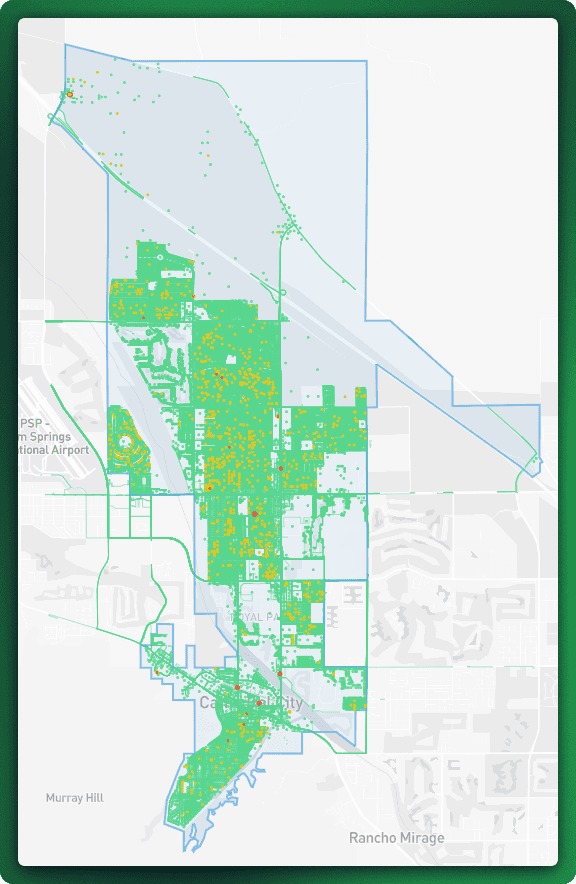
In Cathedral City, two vehicles were outfitted with roof-mounted units beginning in June 2025. Every parcel, roadway, and public right-of-way is assessed automatically and mapped for review by Monday morning.
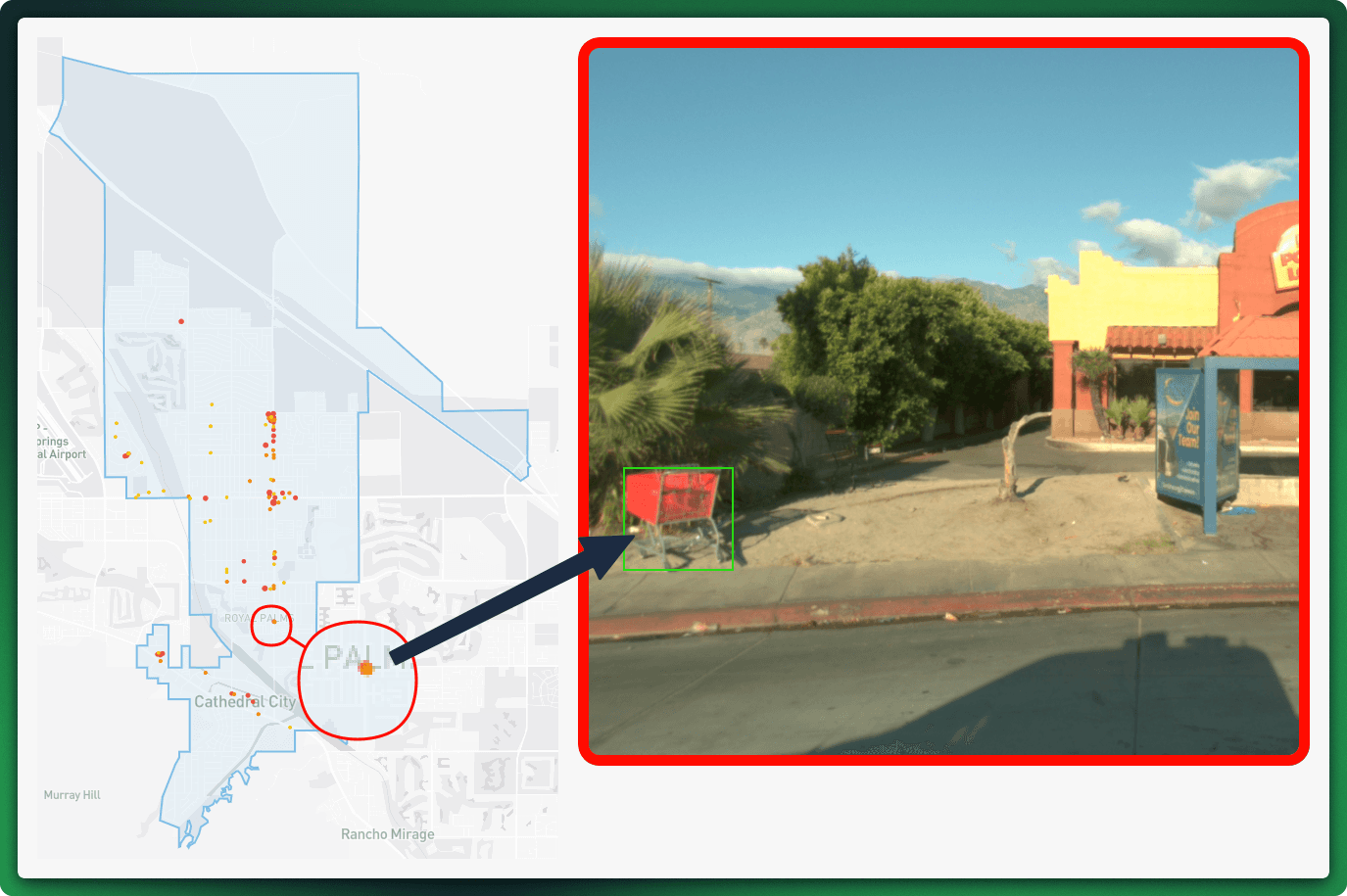
The clearest illustration of the change is also the most unexpected: abandoned shopping carts.
The old way required a four-person crew, a truck, a trailer, and a dedicated scout vehicle. Officers dropped pins on Google Maps as they drove, and a collection team followed behind. This process easily ate up half a day.
Today, Director of Code Enforcement Justin Gardiner runs a report, clicks a button, and sees every cart the system identified during the most recent drive. Another click generates a fully optimized collection route from City Hall and back, exportable directly to Google Maps or Apple Maps. A job that once took four people half a day now takes one officer and a few clicks.
"It's improving and speeding up a lot of our normal processes. It's making us more efficient. And this is important to us, especially when it's 150,000 degrees outside." — Justin Gardiner, Director of Code Enforcement
The Data Behind the Results
Between October 2025 and January 2026, PASS AI® delivered measurable results across Cathedral City's five districts:
186,297 images captured
12,489 parcels analyzed
18,612 roadside detections across 90+ miles of roadway
623 parcel violations identified across 36 code violation types
Detections ranging from vehicles parked on lawns to tarps on roofs and plywood-covered windows
The platform also flags conditions relevant to Public Works such as illegal dumping, graffiti, tire accumulations, and debris. The platform generates GPS-tagged reports with photo documentation that route directly to the Public Works manager. One survey now serves multiple departments.
Education First: A Smarter Approach to Compliance
Cathedral City's enforcement philosophy is deliberate: lead with education, not citation.
When PASS AI® flags a potential violation, the first action is a courtesy notice — a personalized, bilingual letter that includes the actual detection photo, the relevant code section explained in plain language, and a list of local resources for residents who may need help. No case is opened. No officer is dispatched. Not yet.
This is the approach we believe gets the most out of AI detection, and it's why our platform is built to support it from day one. You can see an example in our educational courtesy notice template.
The results speak for themselves:
30–40% of properties reach voluntary compliance before any follow-up
Of roughly 500 courtesy notices sent by mid-December 2025, about 40% of recipients contacted the department within a week
For residents who acknowledge violations but lack the resources to fix them, the city partnered with nonprofits, including Community Action Partnership and the Fair Housing Council, ensuring compliance never becomes an unfair burden on those facing hardship.
Will AI Overwhelm Code Enforcement Departments?
A common fear about AI detection tools is that they'll bury departments in violations. Cathedral City's data shows the opposite.
Of all parcels analyzed, only 4% had any potential code issues. Severe blight affected fewer than 0.3% of parcels in any district; just 14 properties citywide received the most serious designation.
"We intended to focus on egregious cases, and the data showed us that less than 1% of parcels were actually in the worst condition. It allows us to approach enforcement and education with laser focus." — Justin Gardiner
The 354 properties showing minor, emerging issues represent a prevention opportunity, letting the department intervene before small problems become structural ones.
AI That Creates Jobs, Not Cuts Them
Perhaps the most surprising outcome: rather than displacing staff, the technology elevated them.
The department's administrative assistant now monitors compliance trends, generates district-level reports, coordinates with Public Works, and makes strategic decisions about case escalation. Gardiner is now working with an HR consulting firm to create an entirely new job classification, a "Code Compliance Specialist," a hybrid administrative and field role with a specific emphasis on AI system management. According to Gardiner and his consultants, this classification doesn't currently exist anywhere else in local government.
"There will always, always be a human element to code enforcement. We wear so many hats — marriage counselor, enforcement officer, building inspector, you name it. AI doesn't replace that. It makes sure we can apply it where it matters most." — Justin Gardiner
What This Means for the Future of Local Government
Gardiner presented Cathedral City's implementation at the California Code Enforcement Officers (CACEO) annual conference, and he expects broader adoption across the state to be inevitable, more jurisdictions, he believes, will adopt some form of AI technology for their code enforcement teams.
For any municipality navigating constrained budgets and growing community needs, Cathedral City offers a proven model: AI that amplifies, rather than replaces, the people who know their communities best.
Learn More
Read the full Cathedral City case study
Discover City Detect's Code Enforcement solutions (add URL)
Ready to bring AI-powered code enforcement to your city? Contact City Detect to learn how PASS AI® can help your department do more with less.